


Happy New Year, friends. Thank you for being here, reading, learning, and caring about getting it right. I’m wishing you a year of fewer regrets, smarter choices, and a home that feels genuinely good to walk into every day.
As we step into a fresh year, I want to start with something that quietly costs people a fortune: we’re terrible at noticing the money we didn’t waste. Today’s post is about the psychology of invisible wins, and why it can make smart decisions feel like “I missed out.”
Every time I launch a new version of a course, I hear some version of this: “I wish it had been offered this way before.” Sad face.

The same thing happens when a tool or course goes on sale.
Recently, I shifted my Create Your Dream Home: Colour Foundations course from a two-day intensive to a six-week guided experience. A few people who took it earlier wrote in wishing they’d had it “this way.”
And I get that this is better than two full days all at once. That’s exactly why we’re trying it out.
But here’s the thing.
There’s a sneaky little psychological trick behind this regret: it’s too easy to forget that because you’ve had the course under your belt for several months or even years already, you’ve already had months of compounded benefit. Months of better decisions, avoided mistakes including months of savings.
And yet, psychologically, most of us don’t register that value at all.
Because it’s much harder to notice and value savings you’ve acheived for avoiding mistakes. Because it was painless NOT to make those expensive mistakes.
And that’s the point.
One of the most surprising things about working with AI is that it can help you see what’s really driving a situation, not just the surface-level details.
Case in point: my wife and I have had the same argument for 25 years. In many ways, we’re opposites. That’s a huge advantage in life and in business, because our strengths are complementary. But it also means we each have moments where we want the other person to be a little more like us. And that’s usually where the friction starts.
After one of our usual “same argument, different day” conversations that went nowhere, I typed the whole story into AI and asked, “What is actually happening here?”
What came back was uncomfortably accurate in the best way. It named the real issue underneath the argument, which caused a huge breakthrough in our communication and, gave us practical language: what I could say next time, and what I could invite her to say, so the conversation didn’t spiral into the same dead end.
I shared the full story inside my Dream Home Club (including exactly which prompts I inserted to get this result) where I go live every Sunday to talk about whatever is happening in my life. You’ll also get all the sneak peaks of my makeovers in advance.
If you want that kind of support while you work through any of my colour courses, I’d love to see you there! It’s a genuinely wonderful community of people helping each other create beautiful, timeless homes. Join us here.
Ok back to this post. It was AI that explained this phenomenon that I’ve wondered about for decades (not an exageration), and here it is:
The Invisible Value Problem
There’s a well-documented concept in behavioral psychology called outcome blindness.
We are very good at noticing pain we feel. And very bad at noticing pain we avoided.
If you touch a hot stove, you feel it immediately. If you don’t touch a hot stove because someone warned you, there is no sensation. No moment of relief. No emotional marker.
So your brain quietly files it under: nothing to see here.
That’s exactly what happens with education that prevents mistakes.
When you learn how to choose undertone-correct colours before you renovate, nothing dramatic happens. You simply don’t waste $18,000 on the wrong countertops. You don’t repaint your entire house twice. Now you’re not living with an expensive new kitchen or bathroom you secretly hate.
But because the disaster never occurred, your nervous system never logs the win.
The “If Only” Illusion
Here’s another cognitive bias at play: hindsight bias.
Once you see a new version of something, your brain goes: “Oh this is a better deal, ack I really missed out.”
Not really, you had the version that existed at the time, and you used it when you needed it.
Waiting for “the perfect moment” is almost always more wasteful than doing something now. This is true in education, business, investing and it’s true in life.
If that tool or course you got at full price helped you make even one better decision during that time, it already paid for itself.

Time is invisible value. And invisible value is easy to dismiss.
Professionals See This Differently
If your job is to prevent expensive mistakes, you get very good at noticing value that other people miss.
As a colour and design professional, I’m always aware when another expert saves me from a costly error. If someone helps me avoid the wrong decision, I notice it immediately, because I’m trained to see what that mistake would have cost down the line.
That’s also why professionals are quicker to hire professionals. We know what it costs to “figure it out later” or “fix it after it’s wrong”.
I keep my spiritual mentor (really he’s like the fixer in Scandal always knows what to do in any situation) on a monthly retainer. When something comes up, I call him. Some months we barely talk. Other times I might reach out several times in a week. But I always notice when his perspective saves me from an expensive mistake, or helps me make a decision that protects my time, money, and peace of mind. That’s why I pay to keep him close.
In design, the most expensive regrets usually come from finish and colour choices that only reveal themselves AFTER everything is installed. And by then, the fixes are not minor. They’re painful, time-consuming, and expensive.
And more often than not, we don’t fix them at all. The trades are gone, the budget is tapped out, and no one is willing to invite more disruption into the house. So the mistake stays. And that’s the part nobody talks about: a mistake you paid for doesn’t just cost money. It costs you daily. You notice it every time you walk into the room.
That’s why education and foresight are such high leverage. The best value often looks like “nothing happened.” And that’s the point.
And if you’re a design professional reading this thinking, “Yes. This is exactly what my clients struggle with,” you might be ready to add colour consulting to your services, or build a real business around design. I’m teaching in person in Vancouver this March (Canada, this is your chance—I likely won’t be back for years) and Chicago this May. Learn more here.
My Courses Constantly Evolve
We are constantly paying attention to feedback on our courses. We pivot to make them even better.
That’s the nature of growing in what we do. But if you took an older iteration of one of my courses, I invite you to reflect.
“What mistakes did I avoid because I learned sooner?”
If the answer is even one significant mistake, then the value has already been realized.
It just didn’t come with fireworks.

I would love to hear from you! If you took one of my courses, or a previous session of my Create Your Dream Home course, it would make my team and I so happy to hear how it helped you in your projects 💛 Let us know in the comments! Also I’d love to hear if you had the same ‘aha moment’ as I did, learning about what’s behind this kind of FOMO.
Give yourself the luxury of not noticing what didn’t go wrong in your home project. Our new 6-week live support format starts January 16, 2026. The $1,000 price is available until tonight, then it increases. Spaces are limited. Join here.
If you took a previous session and want to upgrade into the 6-week format, email us here, and we’ll send you a reduced rate.
Related posts:
$5000 Colour Expertise vs. a $50,000 Design Firm
Is your Dream Home stuck in “Analysis Paralysis”? Here’s How to Fix It

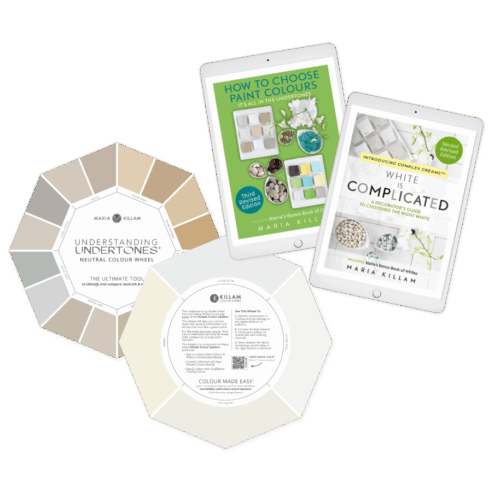


I took Maria’s course about 2 years ago and it saved me $ as I had to pay a company to have the entire interior of a 3 floor townhouse with really tall ceilings painted. I was terrified to pick the wrong color as I was working with bossy travertine floor, LVP color I didn’t like and tile choices I wouldn’t have picked. I would have rather replaced these fixed elements but couldn’t afford to do that. Instead Maria’s course, color wheel and samples enable me to pick the appropriate wall colors and rugs so the fixed elements didn’t bother me. And people that walk in absolutely love how I’ve put everything together, including the furnishings. Although I might have had an idea of what to do, it was thanks to Maria’s training that I achieved the best result.
Thanks so much for this comment Karen! xo