


Last week, I opened my Architectural Digest magazine and found an artist’s home decorated almost entirely in black and white
She said and I quote “Grahic black and white talks to me, I don’t know why it just calms me”. Then she said it had become her signature.
So then I said out loud in a reel on instagram, Well, I know WHY, because it’s been hardcore trending for the past 10 years!!??!!
When we see an aesthetic everywhere for long enough—in magazines, showrooms, restaurants, new builds and Instagram—it starts to feel less like a trend and more like our own personal taste.
Familiarity becomes preference.
And it could be possible that black and white has been her signature long before the trend arrived. But here is my opinion:
A signature is what remains after the trend has moved on.
And then it became an Instagram reel because apparently I still have some feelings about the black-and-white trend, haha.
For years, I was yelling from the rooftops about black windows, black faucets, black hardware, black lighting, black shower frames and black accents being installed in every new build and renovation.
Not because black itself is bad. Because black had become the automatic answer to every design decision.
Need a faucet? Black.
Need cabinet hardware? Black.
Need windows? Black.
Need a chandelier? Also black.
That is unfortunately NOT a considered design plan. It is often simply a trend package.
And because so much of that black was being installed as a fixed element, I knew homeowners would be living with the hangover long after the trend had peaked.
Well, the shift is now unmistakable.
In my eDesign department, we regularly hear from homeowners who want to avoid the stark black-and-white look. They are moving toward warmer woods, softer contrast, richer colour and more nuanced finishes.
But this does not mean every black element in your home must immediately disappear.
Black is not dead. The “black on everything” default is.
Here is how a little black can still be timeless and beautiful.
1. A Classic Black-and-White Floor
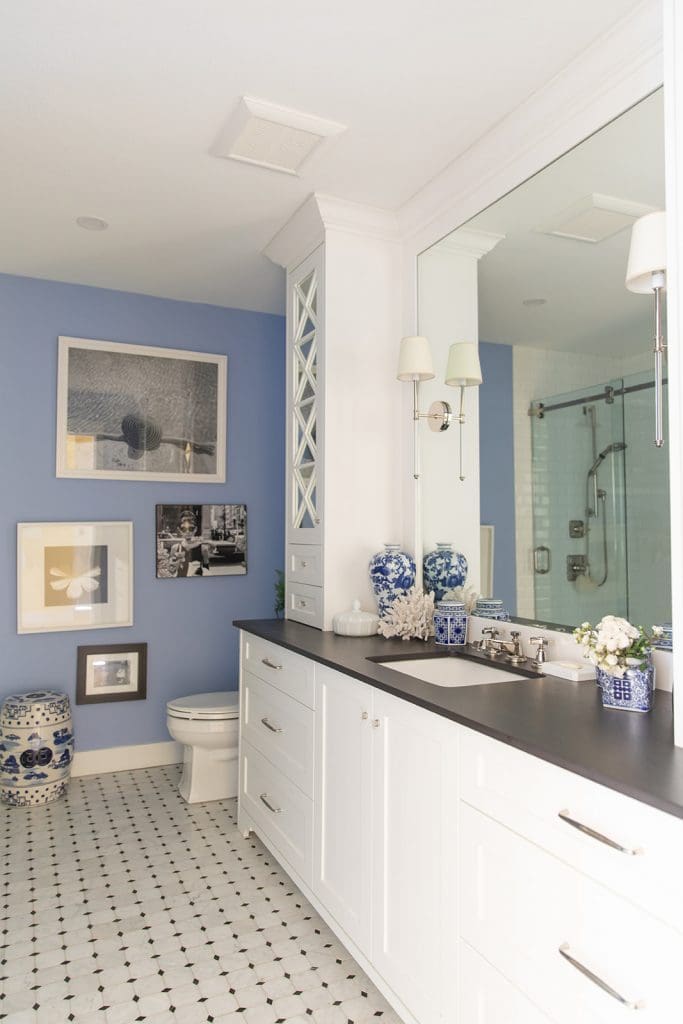
Maria’s Timeless black and white bathroom
A traditional black-and-white mosaic floor will always be a yes in the right bathroom or entry.
Why?
Because it looks exactly the way we expect a classic floor to look. It has historical context. It is not trying to be the newest or most unusual finish in the room.
This was the main bathroom in our bungalow. The black-and-marble mosaic floor was repeated in the leathered black countertop.
At one point, I painted the walls a vibrant green. Later, I changed them to this blue.
But notice that the plumbing fixtures, hardware and sconces are a softer silver finish. I did not repeat black on every small element simply because there was black in the floor.
This bathroom could be painted almost any colour, and the floor would still work.
And by the way, adding colour is one of the best ways to update a modern farmhouse room suffering from an overdose of black and white.
2. A Quiet Black Countertop
A simple charcoal or black countertop can be elegant and grounding, particularly in a kitchen with stainless appliances, which usually already contain some black.
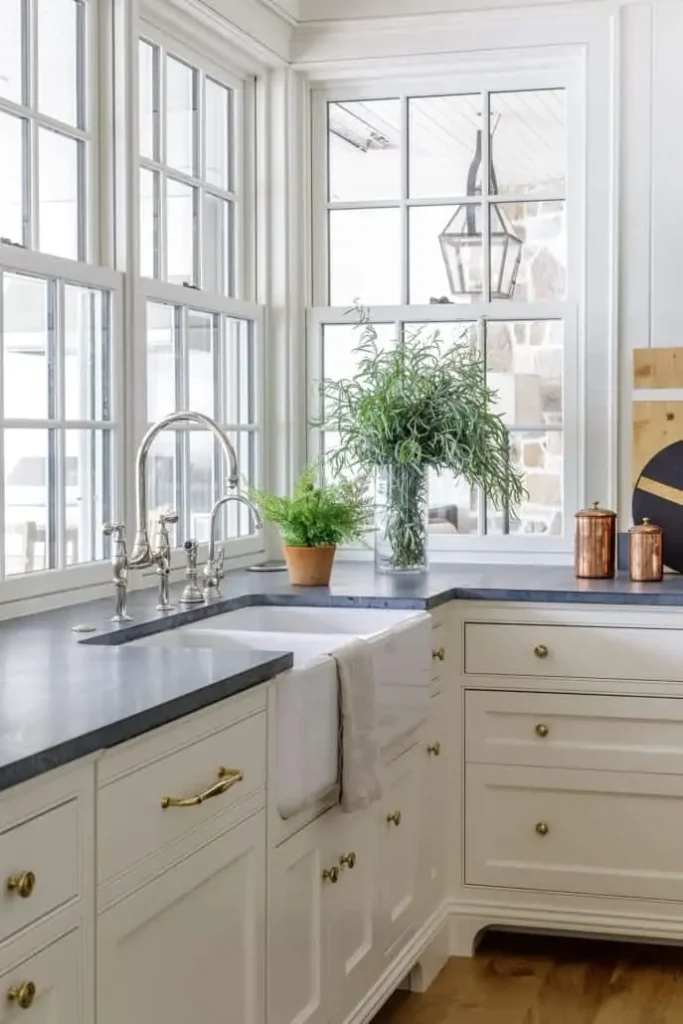
The important word here is quiet.
Choose a honed or leathered surface without dramatic white lightning-bolt veining. Plain and simple is the essence of a timeless hard finish.
Soapstone, honed black granite or another subtle dark surface can create contrast without demanding to be the star of the kitchen.
3. An Architectural Line on a Staircase
A little black in a staircase—perhaps a handrail, slim metal spindles or dark stair treads—can create a sophisticated architectural look.
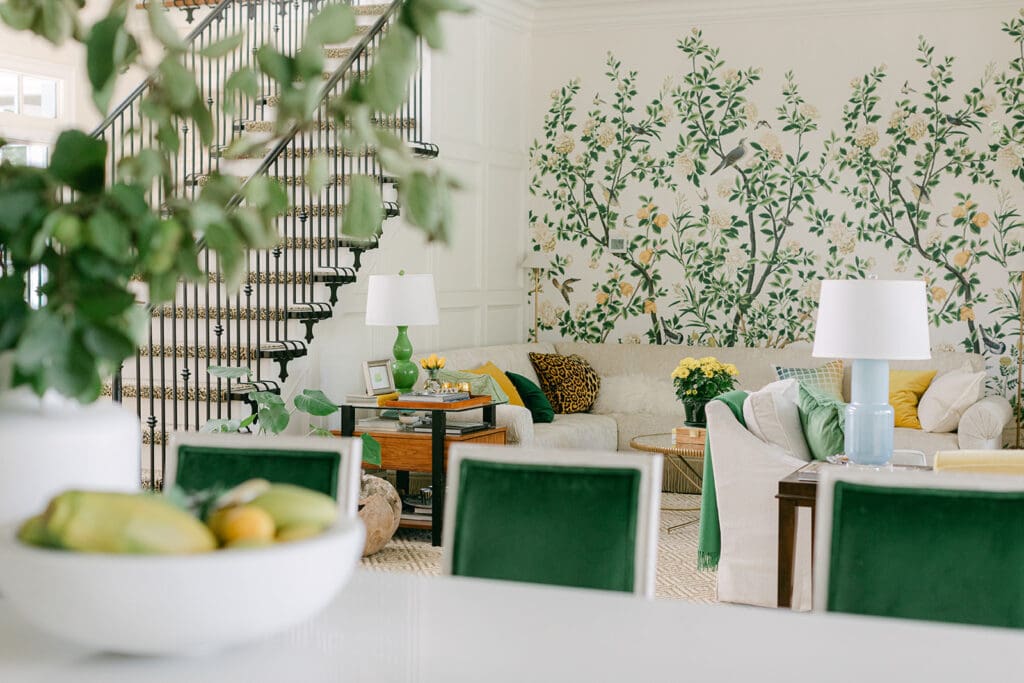
Maria’s Timeless French Country Home
In my house, I had the stair treads painted black to relate to the metal spindles. Refinishing the treads to match the existing wood floors would have been enormously expensive because the work had to be done by hand.
Here, the black has a job. It creates continuity and contrast.
It is not simply another tiny black element sprinkled into the room.
4. One Piece of Black Furniture
When I first moved into this house, I had so many decisions to make, I bought an hour with a celebrity designer I admire to get a fresh perspective on my living room, he told me I needed a black coffee table.
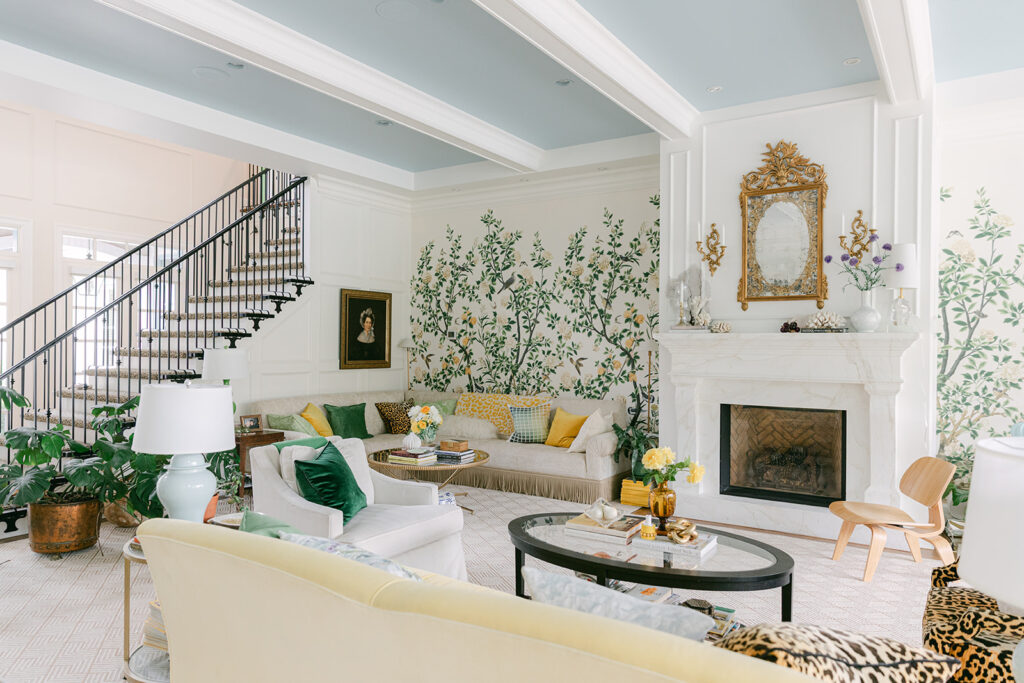
Maria’s Timeless French Country House
At that point, I was so allergic to the black trend that the thought had not even occurred to me.
But he was absolutely right.
The black coffee table created contrast with my yellow sofa and repeated the black stair railing nearby. It gave the room visual weight.
This is the difference between using black deliberately and installing it automatically.
5. Black in Patterned Textiles and Accessories
Patterned rugs, drapery, pillows, art and accessories are the easiest places to repeat a touch of black so that a larger black element feels connected to the room.
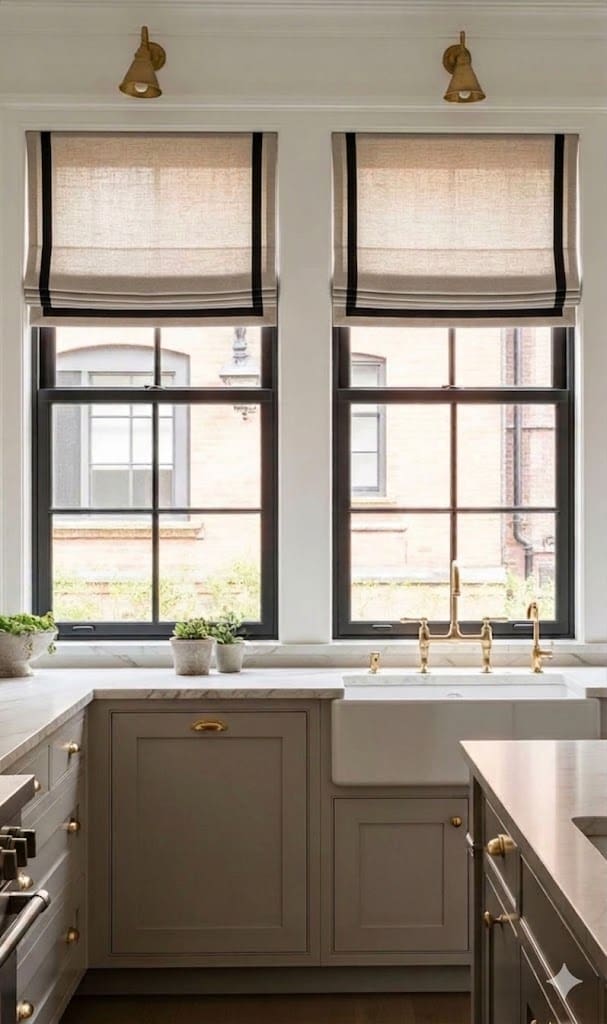
A rug containing a small amount of black might relate to a black coffee table. A narrow black band on a drape could make existing black windows feel more intentional.
And because decorating is less permanent than glued-down finishes, this is where you can experiment.
I recently saw a clever treatment for dressing black windows and had AI recreate the idea so I could show you.
When “A Little Black” Becomes Bitty Black Everywhere
This is where rooms go sideways.
One black element can provide contrast.
But then someone decides that the black faucet requires black cabinet pulls. The cabinet pulls require black sconces. The sconces require a black-framed mirror. Then we add a black shower frame, black towel hooks and a black ceiling light.
Each choice seems harmless on its own.
Together, they create bitty black punctuation in every direction.
The room starts to feel harsh, flat and predictable—and it immediately dates itself to the black-and-white trend of the late 2010s and early 2020s.
A black faucet does not require every other small metal element in the room to be black.
In fact, that relentless matching is often what makes a room look more builder-basic rather than more custom.

What If You Already Installed Too Much Black?
If you’re standing in your kitchen or bathroom right now feeling like you went a little overboard, please don’t panic! It was such a huge trend.
The good news is that these are “small ticket” items.
You can gradually swap out that black faucet for chrome or polished nickel, or change those black cabinet pulls for classic knobs. These are amazing for covering holes from builder boring pulls on everything.
It will immediately soften the look and make your home feel more custom. And don’t forget to paint the walls and cabinets a pretty colour. Transformative.
So yes, a little black is still a good thing.
But black is no longer the automatic answer—and frankly, it never should have been.
Are you team “No More Black” or are you keeping a few classic anchors? Let me know in the comments!
Kitchen Refresh
If you’re standing in your kitchen and you can already tell that swapping a few pulls isn’t going to fix it — that the black went too deep, into the faucet, the lighting, the hardware, the window frames — you need more than a hardware change. You need a coordinated plan for what to swap, what to keep, and what paint and finishes will pull the room back together.
That’s what a Kitchen Refresh eDesign consultation gives you. I’ll tell you exactly which elements to change, what to replace them with, and the wall and cabinet colours that will make the room read custom again instead of trend-dated.
Shop my Essential Tools: Grab my Neutral Colour Wheel to identify undertones and see the four gradations of useful whites.
Related Posts
A Tour of the Black Accents in my Home

What is the beautiful blue ceiling color and brand of paint in the stunning living room with the butter yellow sofa?
I still love the black and white. However, I have added more creams and tans and deleted some of the black. In the kitchen only, I add blue for the summer. I usually add seasonal and holiday colors throughout which go easily with neutral colors. I really need to back off on buying holiday stuff such as fourth of July as I already have too much of it, but it’s my sickness that I always spot something new to add.
This post is so timely as literally last night I was staring at my kitchen, backsplash is a handmade subway tile with black grout. I had copied the look from a kitchen I saw at a friends apt in New York City growing up in the early 90s, which I never forgot. And then I saw the same kitchen in a chef’s home in the West Village. Now looking at it it feels heavy and so trendy because every Builder does the same exact look. It was really a homage to the 1920s staff kitchens , when I did my kitchen it was something you never saw. I was trying to figure out ways to lighten the grout without redoing the entire backsplash, ChatGPT suggested layering more wood elements. I still love my kitchen, but I do love all the browns I see online. I’m currently building a pantry and deciding on the color scheme for the cabinets and countertop and walls and I think again it’s going to be an homage to the old staff kitchens. However it will be a wooden walnut countertop walnut stained glass uppers, and I’m not sure if perhaps White painted lowers. That is the only other style that is constantly drawing my attention, even though online, I see these beautiful high gloss blue lacquer rooms that are so wow I think my taste has always been a brown and white combo. I painted the dining room farrow and ball Sulking Room Pink, it’s not furnished yet but it feels so heavy!
There are grout recolorants (specialized paint really) that work great and endure, with many colors available at the box stores. Doing it yourself is easy if tedious. You can absolutely alter the high contrast of your current grout with that stuff.
I’ve never defaulted to black as a design choice. I have a few “soft” black furniture pieces – an antique, milk-painted hutch, a leather fainting couch, a rocking chair with the wood tones showing through on the armrests. Otherwise imo black is stark and modern, and I’ve avoided it in favor of bronzes and other warm metals. I do have soapstone countertops but if anything I wish they had more veining as I love the movement, even if (and especially?) if they look like lightning-bolts ;).
I love these tips for keeping hard-to-change or timeless black elements. I have some custom-made natural pine and black-stained furniture pieces in various rooms that I plan to keep forever, and honed black kitchen countertops, as well as dark bronze light fixtures (that do read soft black). I still like the grounding effect those have in our house, which is light filled, open concept, and high ceilinged. When we did renovations 9 years ago, I resisted suggestions to go with black faucets, drawer and cabinet pulls, and dining chairs. I’m glad I did, because I’ve gradually added more colour to our black-and-white scheme, and it’s given the house the refreshment it needed.
Before this trend hit, I was in agreement with “every room needs a hit of black.” I still am! –just a PINCH *cough cough*
Just started watching your videos and receiving your emails , throughly enjoying. Look forward to more of your posts.
I’m glad that in smaller doses black and white is continuing. Just like black and white photographs there is a nostalgia that flows from the low chroma look. It also has a more weathered classic European feel without being rustic.
Aaaaaaamen!!!!! Black anchors but too much (of anything) dates. Perfectly said. Another classic, beautifully traditional way to use black is in curtain rods. A famous designer once said that every room needs a touch of black. Like a face needs an eyebrow. I’ve used that recipe for 25 years with clients and will continue for another 25.