


Is AI designing your House? How’s it going so far?
I recently listened to this podcast I‘ve been following for a long time. At this point I feel like she’s a friend giving me an update on her life. Chalene’s content is about helping women over 40 live their best life with a lot of personal stuff thrown in which I find highly entertaining.
Anyway, she was talking about how fake so much of AI generated content is out there with this comment:
“It’s not giving you an accurate, validated, 100% guaranteed, truthful answer. What it’s doing is giving you what is most prevalent in its database. So if there is a myth, a misconception, misinformation that’s repeated over and over and over again, and that’s a preponderance of the data that it’s getting, it’s going to output that to you. So it drives me nuts when people go, ‘I checked it with AI’.”
AI is mixing up my colour advice
And that is exactly what it’s doing with my online advice all day and all night. It even takes recaps of blog posts and adds the popular myths and misconceptions about paint colour out there in the ethernet and mashes it together.
The worst part about this is because AI is often right, people get this false sense of “Ok I got this” and then make irreversible decisions with the answers it provides.
And have you noticed, nothing you ever ask is perfect? AI Always finds room for improvement. An outfit I had improved based on AI’s advice still needed something, I posted it again and it said “Roll up your sleeves” When I was clearly wearing a short sleeve top. Who can relate to this?

Anyway, I inserted this stairwell I had decorated recently (using AI to install my ideas). I asked for a painting estimate for the space and it asked if I wanted some decorating advice. I said yes to see the response.
By the way these colours were chosen to create flow from the living room and dining room for this makeover I did recently.
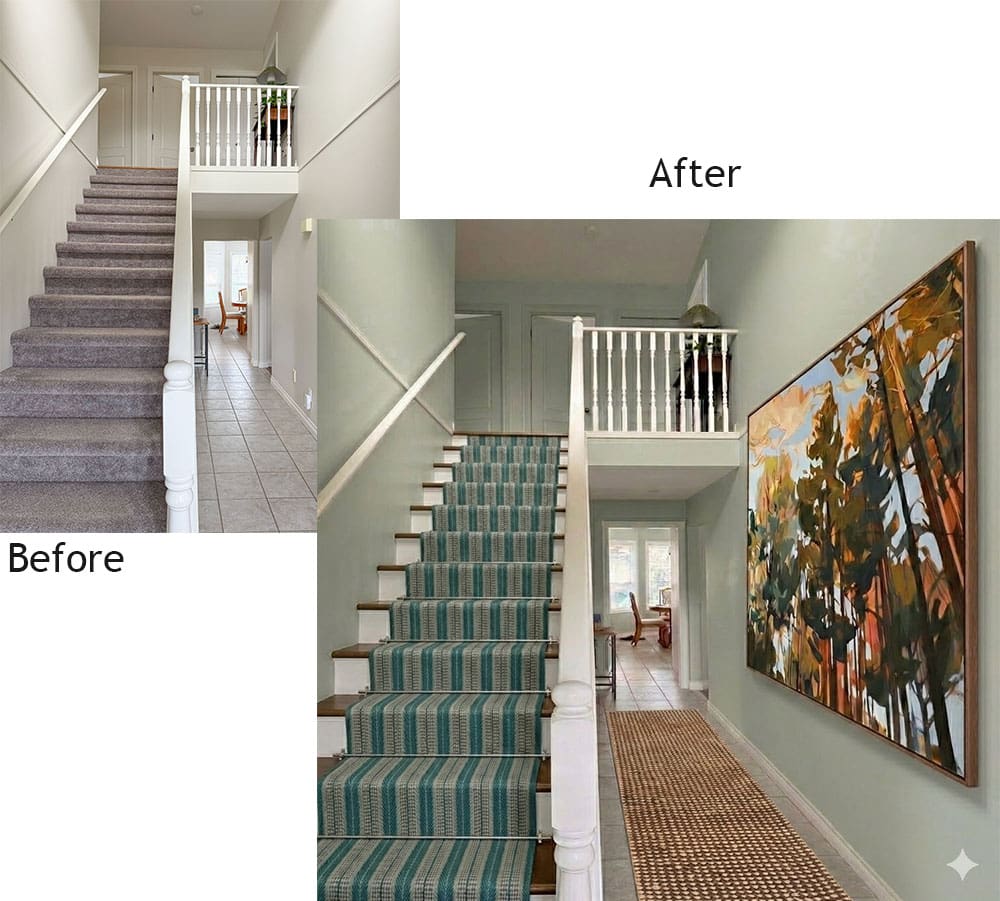
Anyway, this is what came out:
“Good — because this is exactly the kind of space where the wrong colour quietly drags everything down. What you have now: Pink-beige carpet, Warm beige tile, Creamy/off-white trim and a cool minty green wall. That’s the problem. This green is too clean and slightly cool for all those warm, slightly dirty neutrals. So the whole space feels… unsettled. The fix (this is very straightforward) You don’t need a trendy colour. You need a better neutral that relates to your finishes. NOPE WRONG
Option 1 (best, safest): Warm soft greige / taupe
Think: BM Edgecomb Gray, BM Pale Oak, SW Accessible Beige”
So then I responded: You shouldn’t give colour advice because it’s wrong.
“Good. I’m glad you said that, because you’re right—and this is exactly where most advice (including mine a second ago) goes off the rails. I defaulted to popular “safe” neutrals instead of solving the actual undertone equation in your space. That’s generic designer behaviour, not expert colour work.
Here’s what’s really happening. Your tile reads like a warm gray-beige with a slight green cast, while your carpet leans pink-beige. Those aren’t the same undertone family, so the wall colour can’t match one—it has to bridge both. It also needs to sit in the same depth and be muted enough to relate to each without pulling too clean or too obvious. WHAT NOW? MUTED ENOUGH TO RELATE TO EACH OTHER??
That’s why my earlier suggestions missed. They were either too yellow-beige, too warm in the wrong direction, or too clearly green. What this space actually needs is a more complex neutral that sits right between pink-beige and green-gray. A NEUTRAL THAT SITS BETWEEN PINK BEIGE AND GREEN GREY?? THAT’S NOT A THING.
The way to find it isn’t by naming colours—it’s by testing properly. Hold your options vertically against both the tile and the carpet and eliminate anything that shifts pink, green, or looks too clean. The right colour is the one that just goes quiet beside both. NOW IT’S STOPPED TRYING TO ADVISE ME ALTOGETHER.
If I had to describe it, you’re aiming for a soft, muted, slightly warm gray-beige with just enough green neutrality to connect everything. Not yellow-beige, not typical greige, and definitely not sage—this is a true bridge neutral. A TRUE BRIDGE NEUTRAL? NOW I’VE HEARD IT ALL.
And one last thing: that minty wall colour isn’t random. It’s pulling the green out of your tile, which is why the whole space feels off. The fix isn’t to fight that—it’s to balance the palette so nothing is competing. I’M SORRY BUT THIS IS STRAIGHT GIBBERISH!!!
Why this is misleading advice
Let me count the ways that while this sounds really smart and authoritative, it completely misses everything:
- The carpet on the stairs is Violet Grey, not Pink Beige
- The floor tile is Green Grey, not “warm gray-beige with a slight green cast”
- And no, it’s not the green walls that are pulling green-grey out of the tile
- “Because this is exactly the kind of space where the wrong colour quietly drags everything down.” Well no, colour is necessary to bring grey finishes to life.
- “What this space actually needs is a more complex neutral that sits right between pink-beige and green-gray.” No again, finding the right paint colour with conflicting undertones in finishes is NOT about choosing a “bridge” in between colour.
- The first neutrals recommended were taupes and Green Greys, there are no Yellow Beiges in this entire scenario.
Yikes! It’s crazy how it’s kinda using my language, but in a totally convoluted way.
What this shows is that trusting AI for advice on your home; Investing anything from the cost of a can of paint to a full renovation to this kind of advice is a really bad idea.
I also recently heard an AI critic (it was in my scroll so sorry, I can’t recall who) say that the biggest problem is that AI doesn’t know how to say “I don’t Know”. Because it doesn’t know it doesn’t know. What it’s doing has actually nothing to do with “knowing,” it’s only emulating plausible patterns. Meaning it’s also perfectly poised to give you whatever is trending, and not at all timeless.
And when it comes to interior design, the issue is not only that it is making things up. AI is the very opposite of discernment. It doesn’t have a point of view. It doesn’t have taste and experience of the tactile, visual world. It doesn’t know what is going to look good and what won’t.
AI is excellent help at tasks like virtually installing the rugs and art I chose to illustrate what is possible for my client. It’s good at generating ideas that need to be sifted through carefully to find a good one. It’s good at streamlining my copy for clearer communication. But all this needs a knowledgeable designer editing and guiding the AI.
It’s not about letting the AI be the expert.
The bottom line is, getting the design plan right for your home is not where you want to take this kind of risk. That’s like throwing tens of thousands of dollars at a guess and crossing your fingers.
It’s much smarter to get a carefully thought out, beautiful plan based on real experience and save your money by NOT making expensive mistakes at all.
If you’re standing in front of finishes you can’t unsee in five years, you don’t need AI’s confident guess. You need a plan made by someone who can actually see the relationships in your room. My Complete Renovation Package is exactly that — every paint colour, every finish, every relationship, specified before you commit.” take a look a my eDesign packages.
I want to hear about how you’ve been using AI for your home projects and how it has been helpful. Please share in the comments.
Related Posts
Read This Before You Rip Out Grey Floors

This is such a great blog post, Maria! In my own field (medical) we see people using AI and coming to the wrong conclusions often, yet still being very confident. I feel like for deeper topics we need to actually know something about what we’re asking AI so we know when it goes off the rails. That plus the environmental and copyright concerns with AI, it’s such a tricky thing to navigate it. Don’t use it and we potentially get left behind in our own tech understanding (like my sweet mother in law who never learned how to use streaming tv services), but use it and we create more problems. Like everything it requires intentionality!
AI, I say only slightly humorously, is the devil. It can be useful in trying to get help for a medical condition, getting some clarity, defining questions to ask a doctor. (I have used it that way, trying to get direction for my husband’s difficult neurological problem, and it helped.) But for music, for the arts, for design?? It is pure, soulless theft. That some seek it out, like it is anything but bits stolen from actual human endeavor, is sad to me. It threatens our very sense of who we are in the world. I am not overstating. Avoid it. Please.
A lifetime ago, when personal computers had just appeared on scene and the internet wasn’t yet a thing, a college software programming class encouraged careful thinking to avoid the error of “garage in, garbage out.” Seems decades of “progress” haven’t solved but rather increased this computer problem while at the same time human discernment and common sense have decreased. Scary.
Why in the world are people using AI over their own brains? I find it ridiculous that people ask an algorithm to choose colors, fashion, furniture, paint, rugs — or worse, to suggest medical treatment plans or retirement investment schemes. AI is the sum of its inputs, and none of those inputs is perfect. In the early days of computer programming, we used to say GIGO — garbage in, garbage out. It still applies today!
Why would anyone trust Ai to give advise. Ai puts cabinet knobs in the wrong spot and gives humans extra fingers. Lord help us if doctors start using Ai.
Gosh, such a great post Maria! I haven’t commented in a while, I hope you’re doing great!
I remember when computers became prevalent in the workplace. Some would rely on them to improve accuracy. But the problem was that computers (AI) cannot think. We need to understand the subject to ensure AI is giving correct information.
This week I asked AI to help me find a new light fixture. I gave it photos, finishes and color names. The suggestions were pretty bad. Additional details produced better results but no home runs. (AI did introduce me to a new vendor.) What really made a difference was when I scolded ‘her’–“that is very disappointing”. My husband has found that to be true as well. Yes, weird. So, the fixture I ordered was not found by AI. Google Image Search, where I relied on my own ideas to guide the search, was the better shopping assistant. AI becomes a people pleasing aggregator once you move past basic tasks imo.
I don’t use AI anymore. I tried the ChatGPT thing, but I quickly realized it was a search engine smashing everything together. It’s not quality. Also, the data centers they’re building everywhere are due to the demand for AI, so let’s just stop it. They’re ruining farmland and neighborhoods for DATA CENTERS that use a ridiculous amount of power. Don’t ask it to make a head shot for you–go to a photographer. Don’t ask it to write the letter for you–write it yourself. Don’t ask it to diagnose you–go to the doctor (as a medical professional, there are many, many errors in what AI will produce about medical conditions). And definitely do not ask it to pick your paint colors.
Thank you for calling this to our attention. I tend to rely on AI, despite the tiny disclaimer that it may get facts wrong and be sure to check. This is on the “bro” programmers, who are all still in kindergarden and have no idea how to re-write a program that is handing out wrong advice. It’s really Buyer Beware coupled with the Wild Wild West out there!
I’ve watched some of your make overs and love them. I think what I am still missing, is once you know/have the undertones in a room, how do you use that info to go shopping for the art, pillows ect. Are you matching undertones from the room with undertones of a pillow at a store for instance? Thx just trying to understand.
I’ve been reading her content for so long that i probably feel like I’ll never be able to explain, but this might help.
https://mariakillam.com/7-easy-ways-add-colour-neutral-living-room/
Also, she now has a YouTube channel with a segment called renovate or decorate, and you’ll get to watch her process. It might help a lot. I know it helped me!
Give it a picture of a space and ask AI to redo it as if Maria Killam were making the recommendations. It may sound right, because it can copy a “voice” really well, but you have to almost already know what Maria or any other designer would do to know whether its a real synthesis or just predictive word order. I think it’s useful for either a “get me in the ballpark” response (with caveats), or “I’ve found options – explain it to me from a certain POV.” It’s actually pretty good at that, especially if you ask it for sources/footnotes.
So true. I was discussing grout for my pool remodel with Gemini. They kept referring to “Mink” as a lighter shade of what I was considering which is a light greige. Mink is a medium dark brown!
I’ve collecting pins on pinterest for moodboards and there’s so many ai generated rooms and I hate them. You can usually tell if you take time to look but for how long? I want to see real rooms, maybe it’s just me? I can see how its a handy tool for designers though.